

Every business leader carries some version of the same question. Do we have the right strategy, the right products, loyal customers, and enough cash flow to ensure longevity? A baseline level of uncertainty comes with the job, and if it feels heavier than usual right now, you’re not imagining it.
MindSalt clients are saying the same thing: uncertainty feels more prevalent in today’s economy. They’re not alone.
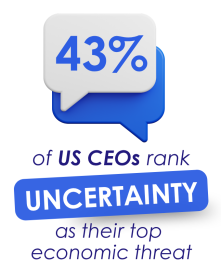
According to The Conference Board’s 2026 C-Suite Outlook survey, 43% of US CEOs rank uncertainty as their top economic threat, well above the 29% of CEOs worldwide who say the same. [1]
Inflation, diverging economic policy, the shifting real estate market, a tighter labor market, and all things AI: all of it points to one thing. We’re living in a transition economy.
Short-Term Wins Can Undercut Long-Term Strength
A transition economy throws off short-term openings: pricing gaps, a competitor’s stumble, a sudden spike in demand. Chasing them can feel like decisive management. However, every dollar and every hour spent on a short-term opportunity redirects future investment that could otherwise build real long-term value. Investing in stronger customer relationships or a more resilient value chain, for example, is a long-term approach that helps ensure your business is still standing when the economy settles down.
- Why it matters: Short-term wins that quietly drain long-term investment can leave a business exposed right when the market shifts again.
- Pro-tip: Before saying yes to an off-lane opportunity, ask what it would cost you to say no and what it would cost your long-term plan to say yes.
As Warren Buffett put it, “You only find out who is swimming naked when the tide goes out.”
The Knowledge You Have Is Your Best Long-Term Investment
One path to long-term strength is reinvesting in what your business already knows and does well. Organizations that invest in their own capabilities are better positioned to grow into bigger roles when opportunities arise, rather than just scrambling to chase short-term plays. The harder part is often knowing where to start. That’s the piece that MindSalt spends the most time on with our clients – finding the foundation to build from.
Assess Your Knowledge Management Capabilities
Start with an assessment of your actual capabilities: the skills, knowledge, processes, and tools you already have internally that can meet a market need even outside your current lane. We break knowledge management down into three distinct types of knowledge.
Explicit Knowledge (data and facts): What you know, how it’s organized, who has access, and whether there’s one clear source of truth.
- Why it matters: If your team can’t agree on which numbers are the real numbers, every decision built on them starts on shaky ground.
- Pro–tip: Identify one system as the source of truth for each key metric and retire the spreadsheets that compete with it.
Implicit Knowledge (know-how): Document the processes, checklists, etc. behind how work gets accomplished well enough that it isn’t lost when a person holding the role leaves.
- Why it matters: An undocumented process is one resignation away from becoming a crisis.
- Pro–tip: Ask your longest-tenured employees to write down the steps they’d never think to explain to someone new. Those are usually the ones that matter most.
Tacit Knowledge (judgement): Shared judgment built through case studies, training, and leadership alignment helps a team make consistent calls as the people making them change.
- Why it matters: This is the hardest kind of knowledge to transfer, and the first thing an organization loses in a leadership transition.
- Pro–tip: Build a habit of walking rising leaders through real decisions, not just the outcome but the reasoning behind it.
Most organizations have haphazard approaches to capturing knowledge. Explicit knowledge around hard data is disorganized, implicit knowledge around processes is unclear, and there’s no solid course of action whereby senior employees and mentors can pass on their experience and judgment to the next generation of leaders.
Capitalizing on organizational strengths and preparing for long-term growth starts with a clear assessment of your knowledge management process and building the right programs around it.
A Learning Organization Is Positioned for Growth
The next big question. How do you shift when you’ve been doing the same thing over and over for decades? For many organizations, becoming a learning organization means asking deeper questions and rethinking where knowledge sits and how your organization acts on it.
Management theorist Henry Mintzberg has long argued that strategy must be fed by frontline knowledge. Managers and employees at every level need to feed what they’re hearing from customers and suppliers back into the strategic conversation. As Mintzberg put it, “The real challenge in crafting strategy lies in detecting the subtle discontinuities that may undermine a business in the future.” [2]
The challenges for leaders are twofold:
- Do you have an effective way to capture insights from the frontlines?
- Are you actually feeding that information into strategic, decision-making conversations on a frequent, regular basis?
Your Next Move
Preparing for uncertainty starts with knowing where your business stands, assessing your unique strengths and expertise, and being ready to apply all of it differently when a situation arises.
MindSalt understands the challenges facing organizations in today’s transition economy. We take an integrated, whole-business approach to help our clients become more purposeful, productive, and profitable no matter the business climate. The strengths are already there. The next step is finding out how ready you are to use them.
AI assistance disclosure: This content was created, edited, and reviewed by MindSalt with AI assistance.
Sources
- [1] The Conference Board, “Survey: CEOs Start 2026 on Edge, Citing Uncertainty as Top Threat” (2026), https://www.conference-board.org/topics/c-suite-outlook/press/c-suite-outlook-2026
- [2] Karl Moore and Phil LeNir, “Mintzberg’s Better Way to Do Corporate Strategy,” Forbes (2011), https://www.forbes.com/sites/karlmoore/2011/06/21/emergent-strategy-demands-emergent-learning/